Britain’s grid upgrades are bringing alternatives to a powerful greenhouse gas into substations. Choosing between them requires a closer look at insulation, fault interruption and the realities of operating electrical equipment.
Switchgear controls electricity flows and helps protect networks by disconnecting faulty circuits. Many designs use sulphur hexafluoride (SF6), a gas that provides electrical insulation and helps extinguish the arc formed when a circuit breaker opens. However, SF6 is a powerful greenhouse gas if released. Alternative-gas switchgear replaces it with gases or gas mixtures that have a lower climate impact, while maintaining the electrical performance required for safe operation.
At London’s Bengeworth Road substation, the shift towards SF6-free switchgear has already reached the equipment delivery stage. In January 2025, National Grid reported the arrival of alternative-gas switchgear for the new 400 kV site, part of its London Power Tunnels project. Britain’s network reinforcement is creating opportunities to reconsider what goes inside the equipment that controls and protects electricity flows.
Sulphur hexafluoride, or SF6, has served that equipment remarkably well. Replacing it means reproducing demanding electrical performance while reducing the environmental consequences of leakage.

Why SF6 is Difficult to Replace
Switchgear has two distinct challenges: insulating live conductors and interrupting current. In SF6 circuit breakers, the gas contributes to both.
SF6 readily captures free electrons, suppressing the electron avalanches that can develop into electrical breakdown. Its strong insulating performance allows compact arrangements of high-voltage conductors. When breaker contacts separate, however, an arc forms and current continues flowing through it.
As explained in NIST’s technical review of insulating and interrupting gases, SF6 combines effective cooling at arc temperatures with electron attachment. Around an alternating-current zero crossing, these properties help extinguish the arc and restore insulation quickly enough to withstand the returning voltage. Opening the contacts alone does not complete the job.
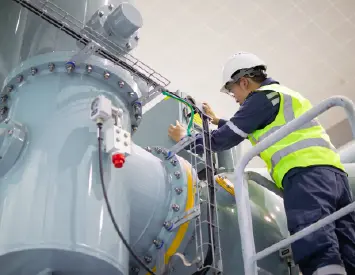
The environmental drawback is substantial. National Grid cites a global warming potential approximately 24,300 times that of carbon dioxide. On this 100-year comparison, one kilogram released represents roughly 24.3 tonnes of CO2 equivalent. Gas retained inside equipment is not an emission, but losses during operation, servicing or decommissioning matter.
Vacuum Interruption Still Needs Insulation
A vacuum circuit breaker interrupts current inside a sealed chamber. Contact separation produces an arc sustained by metal vapour from the contacts. Around current zero, vapour production stops and the gap rapidly recovers its insulating strength, as described in Eaton’s vacuum-breaker operating manual.
That chamber does not provide all the insulation elsewhere in the switchgear assembly. Busbars and other live components still require it. A specification calling for vacuum interruption therefore needs to identify the surrounding insulation medium too.
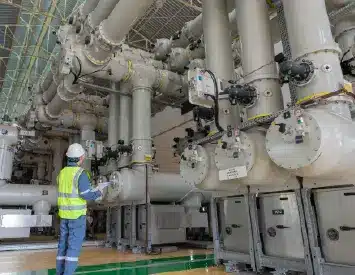
One approach combines vacuum switching with pressurised clean air. Siemens Energy’s Blue portfolio uses this arrangement, removing fluorinated gases from the equipment. The manufacturer also acknowledges that clean-air insulation can increase enclosure size and material requirements. For an urban substation, those dimensions can influence whether equipment fits the available building.
Alternative Gases Carry Different Trade-offs
Other designs retain gas-based insulation and interruption using different mixtures. GE Vernova’s g³ technology, for example, combines carbon dioxide and oxygen with a small proportion of fluoronitrile. The company reports approximately 99% lower gas global warming potential than SF6.
That comparison concerns the gas, rather than the complete switchgear’s lifetime carbon footprint. Manufacturing materials and end-of-life treatment also belong in the assessment. SF6-free equipment containing fluoronitrile remains fluorinated-gas equipment; the label alone does not describe its full environmental profile.
For procurement teams, these differences point towards a practical approach: compare tested equipment at the required voltage and fault duty. Ask suppliers to substantiate operating-temperature limits, gas-handling arrangements and maintenance requirements. Confirm the footprint and replacement-parts strategy before treating alternatives as interchangeable. Replacing gas in existing equipment requires a specifically validated conversion; it cannot be assumed from a new product’s performance.
The Existing Fleet Still Needs Competent Care
UK switchgear guidance, updated on 21 March 2025, requires appropriate F-gas handling certification for work involving SF6. It also sets out leak-checking requirements and exemptions, record-keeping duties, and gas recovery during servicing and before disposal. The update concerns operating responsibilities; it does not itself announce a blanket replacement deadline.
This leaves engineering teams managing existing SF6 assets alongside newer technologies. Fault-level assessment and insulation coordination remain central, while maintenance staff need procedures matched to each equipment design and gas mixture.
ECT’s Bachelor of Engineering (Honours) in Electrical Engineering includes Transformers and Switchgear and Power System Protection. That grounding helps professionals evaluate the electrical duties behind competing equipment claims. A useful specification starts with the fault the breaker must clear, then establishes how the selected technology will remain safe and serviceable throughout its working life.
References
SF6-free, gas insulated switchgear is being installed on our network in the UK
Type 380 VCP-Wind Vacuum Circuit Breakers: Operating and Maintenance Instructions
How to Operate or Service Electrical Switchgear Containing SF6