
The ECT Approach
To enable students to apply practical engineering knowledge to real-world situations in the workforce, students conduct experiments remotely. The Internet of Things (IoT) is responsible for this facility. ECT uses a combination of simulation software, remote laboratories, and interactive online teamwork.
ECT also offers hands-on workshops; an essential component of our learning approach and necessary when students do not have the requisite industry experience.
Remote and Virtual Lab Platform – Electromeet
Our lab hosting platform, Electromeet, connects students to remote and virtual labs for their applied learning. To enable online experimentation and the completion of practical assessments, they access real equipment and a wide range of engineering software via their browsers.
Remote Labs
Just like a traditional engineering lab, Electromeet connects students to remote labs to test and control physical equipment and sensors, and to view the results. These practicals are interactive, controllable, variable, and viewable over webcams – in real-time. The labs include data communication and protocols, scientific instrumentation, physical experimentation, the control and observation of circuits, systems, machinery, and robotic automation.
Virtual Labs
Electromeet hosts simulation software for a multitude of engineering applications, including design, drafting, modelling and analysis, science education, programming, power network design, project management, industrial process control, and virtual plant field operations.
Our bachelor’s and master’s degrees require students to undertake 240 hours of paid or unpaid professional work-integrated learning. Through a combination of internships, site visits, industry project involvement, and networking activities students develop an understanding of work expectations, professionalism, organisational policy and workplace culture.
ECT can assist students with resume development, interview techniques, presentation skills, and making contact with industry.
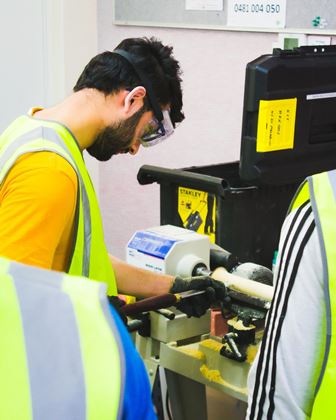 |
The hands-on workshops provide students with tacit knowledge and help build familiarity with the equipment and materials that relate to their disciplines. The workshops also assist students become competent in a range of workplace skills, these include using practical tools, understanding workplace safety and working in an engineering team.
Example of hands-on work activities include:
|
Brands Used in Our Courses
The School of Electrical Engineering will equip you with the necessary skills and knowledge to address the demands of the modern power industry. Electrical engineers are responsible for designing new systems, solving problems, testing equipment, and working on a wide range of components and systems, including communications systems, power plants, electrical machines, navigation systems, and electrical systems for automobiles and aircraft.


Due to rapid developments and evolving technology, the world is becoming increasingly automated. The School of Industrial Automation will equip you with skills and expertise in the latest developing technologies in instrumentation, process control, and industrial automation, which are critical in this fast-moving work environment.


