The countdown to 2027 is a chance to look beyond today’s engineering challenges and consider what comes next. With new technologies and industry demands continuing to evolve, the year ahead could bring fresh opportunities and new priorities for engineering professionals across the UK.
This article looks at four emerging trends that could shape the UK engineering sector in 2027, highlighting the developments and skills that may matter most in the year ahead and the way the Engineering College of Technology (ECT) supports learners in developing relevant expertise through its engineering programmes.
Specialised AI Could Reshape Engineering Work
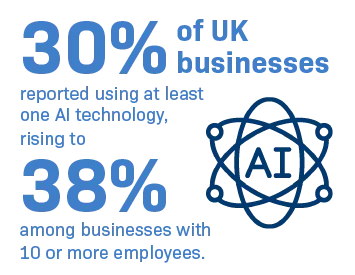
AI is becoming more widely adopted across UK businesses, with applications expanding from content generation to data analysis and operational decision-making. According to the Office for National Statistics, 30% of UK businesses reported using at least one AI technology as of September 2026, rising to 38% among businesses with 10 or more employees.
Looking ahead to 2027, AI adoption is expected to move towards more specialised applications. Gartner, a global research and advisory firm specialising in technology and business trends, predicts that more than 50% of generative AI models used by enterprises worldwide will be tailored to specific industries or business functions by 2027, compared with approximately 1% in 2023. Examples include AI models that generate engineering designs, analyse equipment performance for predictive maintenance, or assist with technical documentation.
What this could mean:
By 2027, AI could move beyond generating text and summarising information to support more specialised engineering tasks. These may include comparing structural design options against project requirements and detecting anomalies in automated production systems. However, specialised AI may not guarantee to eliminate errors. Incomplete data or misinterpreted technical requirements could still result in flawed design recommendations. With this, verifying AI-generated outputs against relevant standards and applying sound engineering judgement will remain essential to protecting safety and performance.
ECT’s Bachelor of Engineering (Honours) in Industrial Automation offers learners an opportunity to strengthen their understanding of industrial control systems and automated processes. These foundations could help them better assess AI-assisted recommendations and identify its potential limitations in industrial environments.
Energy Transition Could Reshape Engineering Priorities
The UK’s transition to a lower-carbon energy system is changing how electricity is generated and managed. As renewable energy capacity continues to grow, engineering priorities are likely to extend beyond building new generation facilities to improving grid connections and maintaining a reliable electricity supply.
The International Energy Agency forecasts that renewables will supply 37% of global electricity generation by 2027, up from 33% in 2025. In the UK, renewables already accounted for a record 52.5% of electricity generation in 2025, while the government aims for clean sources to provide at least 95% of Great Britain’s electricity generation by 2030. These shifts will increase the importance of integrating renewable energy into existing networks with an aim to expand storage capacity to maintain reliable electricity supplies as the energy mix changes.
What this could mean:
By 2027, the challenge will not simply be generating more renewable electricity but managing it when and where it is available.

Wind and solar output can change with weather conditions, while electricity demand fluctuates throughout the day. This could increase the importance of forecasting generation, balancing supply and demand in real time, and deciding when surplus electricity should be stored or redirected. This could place greater emphasis on dynamic power system modelling, smarter grid controls, and improved energy management strategies to prevent network congestion and maintain a stable electricity supply.
ECT’s Bachelor of Engineering (Honours) in Electrical Engineering includes modules in Renewable Energy Systems, Power System Protection, and Big Data Analytics in Electricity Grids. These areas help learners develop the knowledge to analyse fluctuations in renewable electricity generation and assess protection requirements as more wind and solar power enters existing networks. These are relevant to supporting grid reliability as the UK expands its renewable energy capacity.
Digital Systems Could Transform Infrastructure
Digital engineering is already influencing infrastructure projects across the UK, with technologies such as building information modelling (BIM), digital twins, and real-time monitoring supporting design coordination, asset management and infrastructure planning.
A global survey by Bentley Systems, an infrastructure engineering software company, found that more than half of surveyed infrastructure professionals use digital twins in at least some projects. The UK Department for Transport also estimates that integrating digital twins across transport modes could generate more than 1.85 billion in gross economic benefits over ten years.
What this could mean:
By 2027, digital engineering could play a greater role in UK infrastructure planning and maintenance by connecting digital models with real-time asset data.
Digital twins could help teams move beyond monitoring current conditions to assess how infrastructure is likely to perform and test maintenance scenarios before committing resources. This shift will also require better-quality, more up-to-date asset data and improved integration between information systems to ensure that digital models accurately reflect real-world conditions. With reliable data, these tools could support earlier intervention, more targeted maintenance, and better-informed decisions about infrastructure performance.

ECT’s Master of Science in Industrial Automation and Instrumentation Control helps in developing expertise in using Supervisory Control and Data Acquisition (SCADA) systems and industrial data communications to connect equipment and support data-driven maintenance decisions.
Engineering Roles Could Require More Hybrid Skills
Engineering roles across the UK already draw on technical expertise, digital literacy and problem-solving skills to address complex project demands. As AI and digital technologies continue to develop, these skill combinations could become more important by 2027, with professionals potentially needing stronger capabilities in data interpretation and hybrid forms of cross-disciplinary collaboration.
Currently, UK engineering employers continue to face skills shortages, with the Institution of Engineering and Technology’s (IET) 2025 UK Engineering and Technology Skills Survey finding that 76% struggle to recruit for key engineering and technology positions. The survey also found that 42% of employers consider innovative thinking vital for future growth, compared with 39% who prioritise digital and technical expertise.
What this could mean:
By 2027, UK engineering roles could increasingly require hybrid skills that combine technical engineering expertise, digital proficiency and interpersonal capabilities.

This could mean pairing engineering knowledge with data analysis and digital modelling, working effectively in multidisciplinary teams, communicating technical findings to non-specialists, and coordinating projects across remote or hybrid work environments. This could mean that technical expertise alone may no longer be enough to meet evolving project demands because the ability to connect engineering knowledge with digital tools, cross-disciplinary thinking, and effective collaboration could become a key advantage in tackling complex engineering challenges.
Preparing for What’s Next with ECT
These four trends point to a broader shift in UK engineering: future readiness will depend not only on understanding new technologies, but also on knowing how to evaluate their outputs and collaborate across multiple disciplines.
Building expertise in areas such as AI-assisted engineering, renewable energy systems, digital modelling, and multidisciplinary project management could help professionals respond to these changing demands. The Engineering College of Technology (ECT) supports these trends through its engineering programmes in Electrical Engineering and Industrial Automation that help learners strengthen their expertise and prepare to address evolving engineering challenges in 2027 and beyond.

References
Business Insights and Impact on the UK Economy
3 Bold and Actionable Predictions for the Future of GenAI
Electricity Mid-Year Update 2026
Digital twins: Delivering results in design, construction, and operations


