What happens when machines get smarter than the tasks they perform? What becomes to the people who once performed those tasks? In this new era of industrial automation, are jobs disappearing or are roles simply evolving?
Factories are now evolving faster than ever, and artificial intelligence is at the heart of this transformation. This article explores how AI is transforming industrial automation, the benefits it brings to operations, the evolving workforce, the challenges factories face, and the skills engineering professionals need to succeed in this new era of smart factories.
From Simple Machines to Smart Factories
Industrial AI came in gradually as factories added sensors and faster computers over time. These changes eventually gave the machines the ability to notice what’s happening around them and to respond, rather than simply following instructions. What used to be basic automation has now grown into systems that can learn from experience. Here’s a quick look:
Machines that notice what humans might miss: Previously, machines reacted only after a failure occurred. Now, AI continuously analyses pre-processed sensor data like vibration and temperature that can identify problems long before failures occur.
From fixed rules to adaptive learning: Production systems before follow fix rules written by engineers and technical professionals. Now, AI-enabled systems learn from historical and live data taken from a SCADA/DCS/PLC history/trend data. In this manner, AI can advise controllers to adjust processes as conditions change.
Real-time adjustments on the factory floor: Line adjustments before would require manual checks and operator intervention. Now, AI bases advisory systems in conjunction with DCS or PLC as well as advance process control, allow production lines to correct themselves in real time, one that is based on designated and standardised material quality and operating conditions.
Smarter quality checks: Quality control inspections before would depend heavily on keen human eyes and random sampling. Now, AI-computer vision systems inspect every unit and spots defects faster and more accurately.
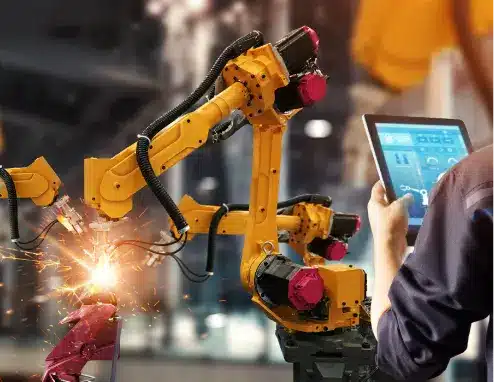
Predictive maintenance becomes the norm: Maintenance before would require actual workers that would respond to breakdowns and sudden outages. Now, AI is based on Machine Learning regression, anomaly decision, digital twins, and high-quality sensors that drive predictive maintenance schedules interventions as early as possible, thus reducing unplanned downtime.
AI in the heart of a unified factory: Intelligence before was separated from different core factory systems. Now, AI is being integrated directly into a unified factory system that connects with robots, controllers, digital twins, and softwares that work simultaneously.
What AI Brings to the Industrial Floor
With industrial AI at the core, machines don’t simply execute tasks anymore, but they observe, analyse, and respond to changes in real time. The real impact becomes clear when we look at the specific ways AI is enhancing operations. Here are some of what AI brings to the factory floor:
Energy efficiency: AI analyses data and sends recommendations to the control system to optimise power usage across machines and systems, and this reduces energy waste and lowers operating costs. Engineering professionals can use this data to identify inefficient processes and justify cost reductions.
Supply chain coordination: AI tracks materials in real time via IoT sensors, RFID, and MES integration, and suggests adjustments to avoid production delays. Engineering professionals can manage inventory and keep production running smoothly.
Worker safety enhancement: AI detects hazardous conditions based on analysis of sensor signals and alert workers before accidents happen. Engineering professionals can monitor safety risks and ensure compliance with workplace regulations.
Customisable production system: AI enables factories to choose and switch between product variants quickly and in a more customised way, depending on production needs and targets. Production engineering professionals can plan flexible schedules and meet customer-specific orders efficiently.
Inventory management: AI predicts demand patterns and minimises overproduction. Engineering professionals can avoid costly excess in inventory and maintain smoother operations.
Sustainability tracking: AI monitors resource usage and waste in real time, and this helps factories meet environmental goals. Engineering professionals can track compliance with environmental standards and demonstrate sustainability improvements.
Remote supervision and collaboration: AI-powered dashboards provide predictive insights and anomaly decisions during remote monitoring and control operations. They can coordinate with teams without being physically present on the floor and identify or resolve issues and make data-driven decisions.
Workforce Impact: Jobs Shifting, Not Disappearing
One of the biggest questions, however, surrounding the rise of industrial AI is its effect on people. Most think that smarter machines would result in fewer jobs. But the reality is different because in this era of industrial automation, roles are evolving, not disappearing. And here’s how:
From operators to overseers: Workers now monitor AI-driven systems instead of manually controlling every machine. This shift can feel difficult at first, as it could require learning new digital tools, but it eventually allows employees to focus on decision-making and in managing the bigger picture rather than repetitive tasks.
From reactive to proactive: Workers act on AI insights to prevent problems before they escalate. This shift can be a bit of a worry for some as it would require taking responsibility for more complex decisions, but this approach would eventually make work more rewarding.
From single tasks to multi-skilled: Workers engage with data analysis, digital tools, and process improvement. This shift might be challenging for it requires adapting to new skills, but mastering these tools would eventually empower employees to contribute more to different engineering and technological fields which can also open opportunities for future career growth.
Collaboration with AI: Workers and machines work together, with AI handling routine tasks while people should focus on human judgement, creativity, and problem-solving. Workers increasingly interact with digital twins, condition monitoring dashboards, advanced sensors, and AI-assisted diagnostics. This shift can feel uncertain for some might find it hard in working alongside smart machines, but one should think of this as a partnership rather than a rivalry.
Challenges and Risks
While the evolving workforce shows the positive side of AI, it’s important to recognise that its presence in industrial automation comes also with challenges. Factories may become smarter, but incorporating AI into daily operations introduces several potential difficulties:
Data quality and integration: AI can only work well if it has accurate, complete, and timely data. AI models require high-fidelity signals from field instrumentation, proper scaling, timestamps, and noise filtering. Disconnected and disorganised systems can reduce effectiveness. Engineering professionals need to ensure that all machines and software are all feeding reliable data.
System complexity: Modern factories involve multiple software platforms. Engineering professionals need to make all these components work together smoothly for this would require thorough planning and continuous coordination between multi-disciplinary teams.
Skill gaps: The use of AI in analysis and process management would require proper training from workers. Engineering professionals need to be familiar with signal conditioning, analytics dashboards, basic statistical concepts, interpreting model outputs, and understanding sensor failure signatures. They are required to develop and work out collaborative programs and workshops that would promote support for career growth and more strategic contributions.
Cybersecurity: AI systems are powerful, but they can also be vulnerable, as it expands attack surfaces because more devices (sensors, gateways, edge units) require network connectivity. Human oversight from engineering professionals is important to protect operations from cyber attacks and data breaches.
Change in culture and management: Even the smartest technology fails especially if people resist it. Human-machine trust must be built through transparency (explainable AI). Engineering professionals would need to maintain communication and enhance collaboration between multi-disciplinary teams to work on challenges and help each other embrace the digital change AI brings.
The Future of Industrial Work: Smart Factories Need Smart Humans
The future of industrial work is not about machines replacing humans, but humans working alongside machines. While AI can assist with routine operations, it does not replace deterministic safety systems or IEC-rated control loops. AI handles the routine and advises while humans oversee, validate, and correct AI recommendations. AI also enables people to focus on creativity, problem-solving, and innovation. Jobs aren’t disappearing but it’s evolving, and the real power comes when humans treat machines as partners, not as rivals.
Through programmes like the Bachelor of Engineering (Honours) in Industrial Automation and Bachelor of Engineering (Honours) in Electrical Engineering, the Engineering College of Technology prepares future engineering professionals to work alongside smart technologies in shaping an innovative future.